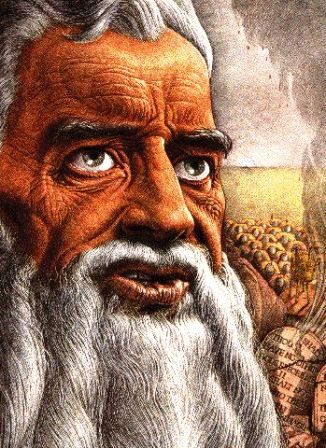
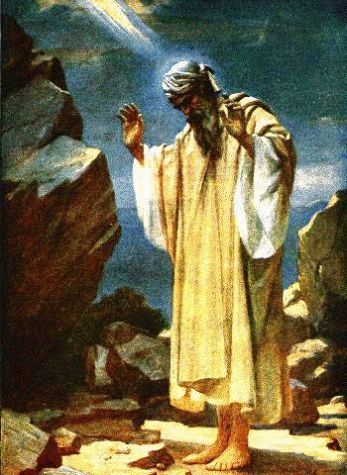
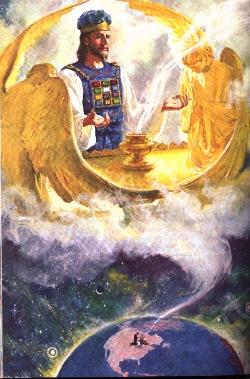
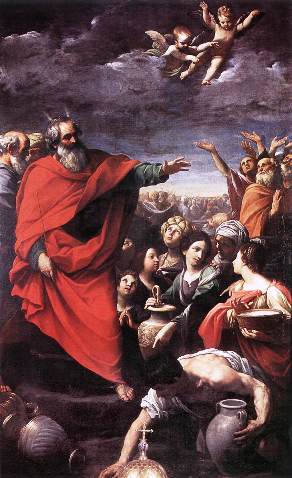
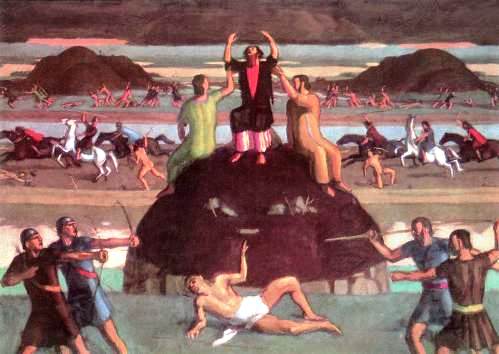
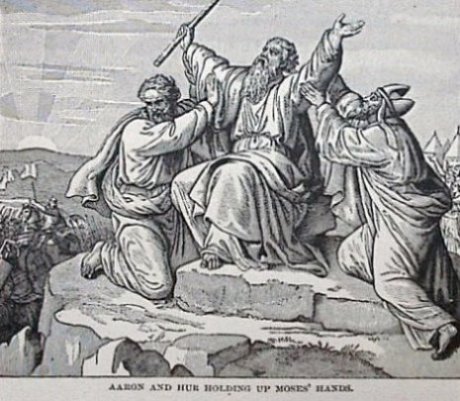
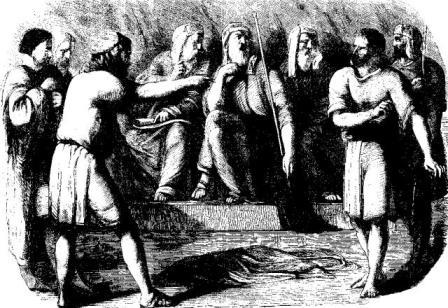
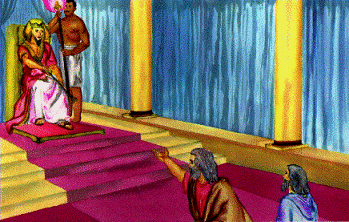
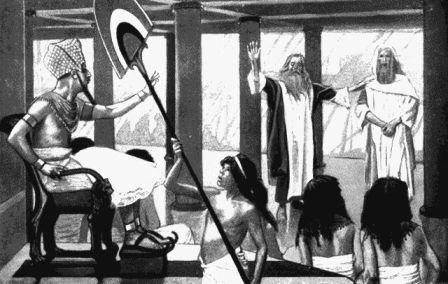
In Genesis chapter 36 we read about Esau’s descendants. One interesting note on verse 11 per Zondervan’s NIV Study Bible – “Eliphaz: Teman – One of Job’s friends was named Eliphaz the Temanite (Job 2:11), and Job himself was from the land of Uz (Job 1:1). Thus Job probably lived in Edom (see verses 28 & 34 in Genesis readings today).” Interestingly, in this year’s Chronological Bible, we will begin reading the book of Job just after we finish reading the book of Genesis! Below is an image of Eliphaz the Temanite and Job:
Worship Video: Today’s readings reminded me of the Brandon Heath song “Give me your Eyes:”
Please join us in memorizing and meditating on a verse of Scripture today: “These were the sons of Israel: Reuben, Simeon, Levi, Judah, Issachar, Zebulun, 2 Dan, Joseph, Benjamin, Naphtali, Gad and Asher.” 1 Chronicles 2:1 NIV
Prayer Point: Pray that the sons of Israel come to know Jesus Christ as their Lord and Savior.
Comments from You: What verses or insights stand out to you in today’s readings? Please post up by clicking on the “Comments” link below!
God bless, Mike
p.s. Download our monthly Small Group study notes for our Chronological Bible readings at this link.
p.s. #2 – Download a schedule of our Chronological Bible readings for the year in PDF format at this link.
p.s. #3 – I would greatly appreciate it if you would pray for this Chronological Bible Blog ministry today! Please also consider partnering with us by financially supporting this ministry. Thank you!
In Chapter 32 we see Jacob preparing to meet his brother Esau. And – we see Jacob praying to God an amazing prayer! Verse 10 is beautiful: “I am not worthy of all the faithfulness and unfailing love you have shown to me, your servant. When I left home, I owned nothing except a walking stick, and now my household fills two camps!” Do you believe that God has been showing faithfulness and unfailing love to Jacob in our readings? Do you believe that God is showing faithfulness and unfailing love to you today? Below is an engraving by the artist Gustave Dore of Jacob praying to God here in chapter 32 (I love this image!):
Genesis Chapter 32 closes out with Jacob in a wrestling match! With God? Or an angel? Or God in the form of an angel? Or Jesus preincarnate? Or Michael the archangel? Biblical commentaries offer a few different views on just who Jacob was wrestling with. Clearly, God ordained whomever was wrestling with Jacob and I do think it could have been God himself in an angelic form. It was obviously not God himself in all of his glory – because He would have whooped Jacob in a wrestling match! 🙂 We do see the quick & fierce power of whom Jacob was wrestling in verse 25 when “he struck Jacob’s hip and knocked it out of joint at the socket.” Please do let me know your thoughts on who Jacob was wrestling this night in the Comments section below?
This painting above from 1855 by Gustave Dore of Jacob wrestling with the angel is one of my favorites! I think it says so much about our faith journey at various stages. I don’t know about you, but there are times when I have wrestled with God over aspects of my faith. It happens at various stages and seasons – sometimes unexpectedly. And I think it is okay to enter into these wrestling matches as long as we ultimately realize that God is in control and we are not. God is going to win the wrestling match. We will not. But, sometimes the wrestling match – the struggle – is something we need to go through to move forward in our faith. Sometimes we need to wrestle with God before we enter the Promised Land, as was the case with Jacob returning to Canaan with his family in our readings in Genesis this week coming up. Below is the French Romantic painter Eugène Delacroix’s “Jacob Wrestling the Angel” from the year 1861:
This is what I love about the chapters of Genesis that we are entering into with our readings now – we read about imperfect humans, not so unlike us, trying to make sense of their lives and their relationships with God. Sound like anyone you know? 🙂 In this early part of the Bible we are shown a God who is willing to wrestle with us, if we need to wrestle. A God who gives us dreams that end up saving a family that will soon become a nation that will save the world. A God who moves us into places and lands and situations to where we need to be to fulfill His perfect will. And in the midst of all of this – we read about imperfect humans that make mistakes. And God still can work through those mistakes and redeem mankind. This is incredible narrative in our readings coming up this next week in Genesis! Below is Rembrandt’s “Jacob’s Struggle with the Angel” from the year 1659: (can you tell by all the paintings I’m posting up here that I’m fascinated by this wrestling match… 🙂
Chapter 32 verse 28 is an incredibly important verse: “”Your name will no longer be Jacob,” the man told him. “It is now Israel, because you have struggled with both God and men and have won.”” This is interesting to know! Israel means “God struggles” or “one who struggles with God.” It is also interesting I think to see that God gives people new names at times in the Bible, and the names are reflective of their new lives with God. Abram becomes Abraham. Sarai becomes Sarah. Jacob becomes Israel. Simon becomes Peter. Okay, no more wrestling images… 🙂 Below is stained glass artwork from the Duomo Cathedral in Milan, Italy of the angel blessing Jacob:
Today’s Genesis chapter 32 starts off with Jacob preparing presents for Esau. Overall, I thought this was pretty smart. I suppose in some ways you could look at all this as bribery… 🙂 But, I guess I thought Jacob was demonstrating some good business / political principles here. This is something that I do struggle with at times in my own life – a balance of utilizing good business principles versus relying completely on God. I suppose you could argue that Jacob should have simply relied on God to prepare the way for Jacob’s meeting with Esau. And this would be a good argument – Esau had become wealthy over the years himself, and seemed to have forgiven Jacob before they met up here again. Though, if you were in Jacob’s shoes, think about how you would have had no way of knowing this… and think about the last time you saw your brother 20 years earlier and how that ended… I do think that while clearly our reliance should be on God and His work and providence first and foremost, I believe God also wants us to be actively partnering with him. So, I think after we first pray to God about a situation, we should also do the work that we are called to do by God for the situation as well. This is where I think good business / political principles can come into play – as long as they are clearly aligned with the will of God. Again – a fine line to walk, and a line that can only be blessed by the Holy Spirit. We cannot walk this line on our own power or smarts. Do you pray to God to show you the work He wants you to do in your life? Do you also ask God to show you the work to be done in various situations that arise in your life? Do you enjoy working with God?
In Genesis chapter 34 Jacob and Esau meet again! I found verses 5 through 7 interesting. Jacob presents his concubines and sons first – then Leah and sons – and then Rachel and Joseph. I read a commentary that he was keeping his favorite wife and son back, as the last presentation to Esau – just in case anything should go wrong with Esau and the introductions of his family… Meaning, if any violence erupted – Rachel and Joseph would hopefully be removed from it. Below is an image of Esau and Jacob meeting in verse 4: “Then Esau ran to meet him and embraced him affectionately and kissed him. Both of them were in tears.” Below is Flemish Baroque painter Peter Paul Rubens’ “The Reconciliation of Jacob and Esau,” from the year 1624:
In verse 14 of this chapter we see Jacob likely being deceitful again: “So go on ahead of us. We will follow at our own pace and meet you at Seir.” He did not follow Esau and meet him at Seir, as we will see in the next chapter. And commentaries suggest Jacob never intended to go to Seir. Below is a pretty good map showing you where some events in this chapter took place: Peniel, where Jacob wrestled with God – Shechem in chapter 34 – and Seir is basically where you see Edom on the map, just south of the Promised Land.
Genesis chapter 34 is a chapter where we see a lot of violence… It is interesting to note that the name of God ends chapter 33 and begins chapter 35, but is completely absent from this chapter! The NIV Study Bible has this note about this chapter: “Jacob is now confronted in the promised land with the danger of being absorbed by the native Canaanites (verses 9 & 16), and then with the threat of their hostility after his sons’ vengeful act (verse 30). These were dangers Israel constantly faced from the peoples around them – either absorption or hostility, both of which are perpetual threats to God’s people.” As there is so much going on in this chapter, I highly encourage you to spend a few minutes with Bob Deffinbaugh at bible.org for his commentary on Genesis chapter 34 – surf down to about mid-page at this link for ch. 34. Below is a 13th century French miniature painting of Simeon and Levi taking Dinah from Shechem:
Today is a big day for Jacob in that he finally returns to Bethel – the same place where his pilgrimage began with God in Genesis 28:10-22! Bethel is where Jacob had his dream of the angels ascending and descending the staircase, when he was leaving the promised land for 20 years in Haran. Below is a map of Jacob’s journeys for his entire life:
Bethel was the place where God first gave to Jacob His covenant promise that was also given to Abraham and Isaac – and the covenant promise is reconfirmed in today’s readings in chapter 35 verses 11 and 12: “Then God said, “I am God Almighty. Multiply and fill the earth! Become a great nation, even many nations. Kings will be among your descendants! And I will pass on to you the land I gave to Abraham and Isaac. Yes, I will give it to you and your descendants.” These 2 verses are essentially thought to be the climax of the Isaac-Jacob portion of Genesis. In tomorrow’s readings we begin the Jacob-Joseph portion of Genesis. (which is an amazing narrative that begins tomorrow…) The covenant continues!
Bible.org’s commentary on today’s readings in Genesis chapter 32 titled “How to Win with God and Men” is at this link.
Worship Video: Today’s readings in Genesis 32 of Jacob struggling with God reminded me of Britt Nicole’s song “The Lost Get Found:”
Please join us in memorizing and meditating on a verse of Scripture today: “Then the man said, ‘Your name will no longer be Jacob, but Israel, because you have struggled with God and with humans and have overcome.’” Genesis 32:28 NIV
Prayer Point: Pray that if you ever struggle with God, that you let God win. Pray that you struggle for the salvation of people’s souls in your life today.
Comments from You: What verses or insights stand out to you in today’s readings? Please post up by clicking on the “Comments” link below!
God bless, Mike
p.s. Download our monthly Small Group study notes for our Chronological Bible readings at this link.
p.s. #2 – Download a schedule of our Chronological Bible readings for the year in PDF format at this link.
p.s. #3 – I would greatly appreciate it if you would pray for this Chronological Bible Blog ministry today! Please also consider partnering with us by financially supporting this ministry. Thank you!
Today’s Genesis chapter 30 readings bring us the account of several of Jacob’s sons and a daughter being born to Leah, Bilhah, Zilpah, and Rachel. We also read about Jacob gaining wealth and wanting to leave his father-in-law Laban’s house to go back home in Genesis chapter 30. In verse 37 we read: “Now Jacob took fresh shoots from poplar, almond, and plane trees and peeled off strips of the bark to make white streaks on them.” It seems in this verse and the ones that follow that Jacob is getting a bit superstitious – and not really asking God for help. Later Jacob does admit that God did do the work of increasing his wealth, and that he didn’t do it on his own with his superstitions, as we see in Chapter 31 verse 9 when Jacob is speaking to his wives Rachel & Leah: “In this way, God has made me wealthy at your father’s expense.” I think it’s great to see that Jacob starts to realize more and more that God is in control. I wonder for us, today, do we sometimes act like Jacob with the sticks – and rely on superstition or our own power, when we should be relying solely on God? Are there maybe areas in our work life or personal life where we think we are running the show? Are we really? Or is God? Will we let our superstitions go, and embrace the reality that God is in control? And – who better is there to be in control, really? 🙂 Actually – I’ll share with you a quote someone shared with me once when I was really trying to micromanage a situation – and was worrying and fretting way too much about the situation. The quote is simply this: “Let go and Let God.” Let us let go of what we are hanging on so tightly to if it is not of God – and let us instead let God run the show. Are there areas in your life where you need to “Let go and let God”? Below is a painting by Spanish painter Jusepe de Ribera from the year 1632 of “Jacob and Laban’s Flock”:
Today’s Genesis chapter 31 readings take us through Laban’s pursuit of Jacob and his family and Laban & Jacob’s treaty. In this chapter we read about Rachel taking Laban’s “household gods”, which were worthless idols – and yet both Laban and Rachel were very attached to idols, which was common in pagan religions of that time. Idols were often family heirlooms that were passed down from generation to generation and could sometimes signify that someone would receive their family’s estate if they received the idols. People believed idols could bring blessings – and Laban obviously wanted them back. Though, I think he wanted more than just his idols back – I think he also wanted control over Jacob and his family back. In verses 33 & 34 we read: “Finally, Laban went into Rachel’s tent. Rachel had taken the household gods and had stuffed them into her camel saddle, and now she was sitting on them. So although Laban searched all the tents, he couldn’t find them.” Rachel was cunning like her husband Jacob! Below is a fresco painting from 1729 by the Venetian artist Giovanni Battista Tiepolo titled “Rachel Hiding the Idols”:
Verse 42 stood out to me in today’s readings as Jacob spoke to Laban: “In fact, except for the grace of God–the God of my grandfather Abraham, the awe-inspiring God of my father, Isaac–you would have sent me off without a penny to my name.” I like seeing that Jacob is realizing that the grace of God has blessed him! I wonder if sometimes in our lives the grace of God is blessing us, and we don’t realize it? Do you ever have those moments when you look back on a day, or a week, or even a year and realize that God’s grace was so there – and yet… you didn’t realize it at the time? Will you try to live more like Jacob in this verse – and recognize awe-inspiring God’s grace more and more frequently in your life? And can you give praise to God for this ever-present ever-dependable gift of grace that is available to you?
Bible.org’s commentary on today’s readings in Genesis chapter 30 titled “The Battle of the Brides” is at this link and commentary on chapter 31 titled “Jacob gets Laban’s Goat” is at this link.
Worship Video: Today’s readings in Genesis reminded me of the Switchfoot song “Restless:”
Please join us in memorizing and meditating on a verse of Scripture today: “Then the LORD said to Jacob, ‘Go back to the land of your fathers and to your relatives, and I will be with you.’” Genesis 31:3 NIV
Prayer Point: Pray that you will listen and obey the Lord each and every day of your life. Pray that you know that the Lord is always with you, if you are in a saving relationship with Jesus Christ as your Lord and Savior.
Comments from You: What verses or insights stand out to you in today’s readings? Please post up by clicking on the “Comments” link below!
God bless, Mike
p.s. Download our monthly Small Group study notes for our Chronological Bible readings at this link.
p.s. #2 – Download a schedule of our Chronological Bible readings for the year in PDF format at this link.
p.s. #3 – I would greatly appreciate it if you would pray for this Chronological Bible Blog ministry today! Please also consider partnering with us by financially supporting this ministry. Thank you!
Today’s Genesis chapter 28 readings begin Jacob’s adventure as he leaves the land promised to Abraham and Isaac and heads for Paddan-aram to stay with his uncle. Jacob’s dream at Bethel is awesome in this chapter! While this dream is often referred to as “Jacob’s Ladder,” many commentaries say it was probably stairs that Jacob dreamt of – similar to the stairs of a ziggurat (think tower of Babel) that winded around the outside of the tower on the way up. Have you ever had a dream anything like this one? 🙂
I do have to admit – Jacob’s story and the parallel stories of his uncle Laban, Jacob’s wives, and his sons – culminating with Joseph in Egypt – is one of my favorite parts of the Old Testament. This is just good narrative! I think one thing that really opened my eyes to all of the small details of the story of Jacob is that I was in an amazing Bible study for about a year going through this part of Genesis. I don’t know if you’ve been in a group Bible study before? If not, let me encourage you to join one! They are incredible. You get so many different perspectives from each person in the group – similar in some ways to what you are getting here on this blog – but more personal and I think far better. You get to go through the text with other people and really dive into things – and even have some fun joking around about things. If the church you attend has some sort of Bible study, will you consider checking it out this month of January? I know you will be incredibly blessed by this decision!
I found verses 21 & 22 intriguing: “Then Jacob made this vow: “If God will be with me and protect me on this journey and give me food and clothing, and if he will bring me back safely to my father, then I will make the LORD my God.” Do you notice the “if” / “then” statement in this vow from Jacob? Jacob is putting some conditions on what it will take for him to make God his God. Do we do this in our lives sometimes? Do we try to put “conditions” on God? Does this really make sense to do? What if our conditions are not met? What if things don’t go as planned? Will we still love God as our God, even if the “conditions” in our life are not met or are not ideal?
In Genesis chapter 29 Jacob arrives at Paddan-Aram, which was close to Haran. See this map below for where Jacob will spend the next 20 years of his life. All 12 of his children besides Benjamin will be born in this land! Note that this map below shows arrows going from right to left – because it’s really a map of Abraham’s early journey. 🙂 But, you can see how far Jacob traveled from Bethel – where he had the dream discussed above – to Haran / Paddan-Aram at the top of the map.
In this chapter Jacob meets Rachel and Laban, and works for 7 years to marry Rachel – except for the fact that Jacob was deceived by Laban on the wedding night! Which is a bit ironic, as we have seen in recent chapters that Jacob did some deceiving himself… I read one commentary that said for most of his life Jacob was so focused on getting the rights of the first born from his father Isaac – and now he must accept the rights of the first born in this surprise marriage to Leah! At the end of today’s readings we see that Leah is beginning to have sons – including Levi who will be the ancestor of the Aaronic priestly line of Israel, and Judah who will be the ancestor of King David and ultimately Jesus Christ. Below is an oil painting from 1836 by Bohemian painter Joseph von Fuhrich of Jacob encountering Rachel with her father’s herds in verses 9 – 11: “As this conversation was going on, Rachel arrived with her father’s sheep, for she was a shepherd. And because she was his cousin, the daughter of his mother’s brother, and because the sheep were his uncle’s, Jacob went over to the well and rolled away the stone and watered his uncle’s flock. Then Jacob kissed Rachel, and tears came to his eyes.”
Bible.org’s commentary on today’s readings in Genesis chapter 28 titled “The Seeker Is Sought” is at this link and commentary on chapter 29 titled “I Led Two Wives” is at this link.
Worship Video: Today’s readings in Genesis about Jacob’s dream and his many years of work for Laban reminded me of the FFH song “Come Undone:”
Please join us in memorizing and meditating on a verse of Scripture today: “When Jacob awoke from his sleep, he thought,’Surely the LORD is in this place, and I was not aware of it.’” Genesis 28:16 NIV
Prayer Point: Pray that you are aware of when God is with you. Pray that through your saving faith in Jesus Christ as your Lord and Savior, God is with you always.
Comments from You: What verses or insights stand out to you in today’s readings? Please post up by clicking on the “Comments” link below!
God bless, Mike
p.s. Download our monthly Small Group study notes for our Chronological Bible readings at this link.
p.s. #2 – Download a schedule of our Chronological Bible readings for the year in PDF format at this link.
p.s. #3 – I would greatly appreciate it if you would pray for this Chronological Bible Blog ministry today! Please also consider partnering with us by financially supporting this ministry. Thank you!
In Genesis chapter 26 we can see where the old adage, “like father, like son” could have come from. Isaac like his father Abraham told foreigners that his wife was his sister. However, the artist Raffaello captured verse 8 from King Abimelech’s perspective in this painting from the year 1519 below: “But some time later, Abimelech, king of the Philistines, looked out a window and saw Isaac fondling Rebekah.”
Today’s Genesis chapter 26 readings open up with Isaac digging wells – and then moving on when the Philistine’s contest the wells. This shows an incredible amount of patience on Isaac’s behalf. In this arid region of Gerar, water was like gold and people often battled over water. Filling in someone’s well was akin to declaring war. Below is an aerial map of where Gerar and Beersheba are located, just on the northern edge of the Negev desert (see lower left corner of map):
Verse 22 stood out to me in these readings about the wells: “Abandoning that one, he dug another well, and the local people finally left him alone. So Isaac called it “Room Enough,” for he said, “At last the LORD has made room for us, and we will be able to thrive.”” For me this was reminiscent of Abraham giving Lot the choice of lands when there was disputes between their herdsmen. Abraham was confident that God would provide even with “2nd choice” of the lands – and Isaac here seems to be following in his father’s footsteps of wisdom. I also like the naming of the well – “Room Enough.” I think sometimes in our world today we can get so competitive with each other, thinking that there is a limited sized pie and we have to get our piece of it! “The Seven Habits of Highly Effective People” author Steven Covey calls this the “scarcity mentality” – and he encourages us to instead operate with an “abundance mentality” – that there is ultimately enough pie for everyone. That there is Room Enough. How do you find yourself operating in your own life – more often out of the scarcity mentality or the abundance mentality? Do you see the risk of the scarcity mentality? And the blessing of the abundance mentality? Do you believe that there is Room Enough? Below is a modern day photo of a well near the entrance to Beersheba that is believed to be the well Isaac and his servants dug in chapter 25 verses 23-25: “From there Isaac moved to Beersheba, where the Lord appeared to him on the night of his arrival. “I am the God of your father, Abraham,” he said. “Do not be afraid, for I am with you and will bless you. I will multiply your descendants, and they will become a great nation. I will do this because of my promise to Abraham, my servant.” Then Isaac built an altar there and worshiped the Lord. He set up his camp at that place, and his servants dug another well.”
Genesis chapter 27 today is a very interesting and challenging chapter… both Jacob and Rebekah are deceitful. And Isaac is suspicious of the whole charade. And yet, Jacob receives the verbal blessing from Isaac, which was binding back in those days. I think this chapter is challenging in that it can bring up the question of sin – and can sin be used to fulfill God’s will? You know I’m going to defer to our resident-expert on Genesis – Bob Deffinbaugh from bible.org. 🙂 Check out this quote from Bob in his summary of this chapter: “The purpose of God as expressed to Rebekah in Genesis 25:23 was perfectly accomplished without one alteration. The sins of Isaac and Esau and Rebekah and Jacob did not in any way thwart God’s will from being done. In fact, their sins were employed by God in such a way as to achieve the will of God. God’s sovereignty is never thwarted by man’s sin. To the contrary, God is able to achieve His purposes by employing man’s sinful acts to further His plans.” Then, check out everything Bob has to say on this challenging chapter at this link. Surf down to Bob’s Conclusion at this link if nothing else – it is very intriguing! Please let me know your thoughts on this chapter in the Comments below. Below is an oil painting from 1639 by Dutch Baroque painter Govert Teunisz Flinck (who was a pupil of Rembrandt) of Isaac blessing Jacob:
Bible.org’s commentary on today’s readings in Genesis chapter 25 titled “The Principle of Divine Election” is at this link and commentary on chapter 26 titled “Isaac Walks in His Father’s Steps” is at this link.
Worship Video: Today’s readings reminded me of Michael W. Smith’s song “You Won’t Let Go:”
Please join us in memorizing and meditating on a verse of Scripture today: “May nations serve you and peoples bow down to you. Be lord over your brothers, and may the sons of your mother bow down to you. May those who curse you be cursed and those who bless you be blessed.” Genesis 27:29 NIV
Prayer Point: Pray that the nations may serve and bow down to Jesus. Pray that all peoples will acknowledge Jesus as Lord.
Comments from You: What verses or insights stand out to you in today’s readings? Please post up by clicking on the “Comments” link below!
God bless, Mike
p.s. Download our monthly Small Group study notes for our Chronological Bible readings at this link.
p.s. #2 – Download a schedule of our Chronological Bible readings for the year in PDF format at this link.
p.s. #3 – I would greatly appreciate it if you would pray for this Chronological Bible Blog ministry today! Please also consider partnering with us by financially supporting this ministry. Thank you!

Our readings are brief today! In Chapter 25 verse 19 we begin reading about Jacob and Esau. Jacob we will read about for a large portion of the remainder of Genesis – there is actually not that many chapters we will read about Isaac. Tomorrow, in verse 34 we read this about Jacob & Esau: “Then Jacob gave Esau some bread and lentil stew. Esau ate and drank and went on about his business, indifferent to the fact that he had given up his birthright.” Below is Dutch Baroque Era painter Hendrik Martensz Sorgh’s beautiful “Interior with Jacob and Esau” painting from the year 1662 (the bright foreground almost takes away from the background with Esau swearing off his birthright):
Worship Video: Readings about Abraham’s death today and reflecting back on his life reminded me of the Delirious song “Majesty!” Here’s a great live version of this song:
Comments from You: What verses or insights stand out to you in today’s readings? Please post up by clicking on the “Comments” link below!
God bless, Mike
p.s. Download our monthly Small Group study notes for our Chronological Bible readings at this link.
p.s. #2 – Download a schedule of our Chronological Bible readings for the year in PDF format at this link.
p.s. #3 – I would greatly appreciate it if you would pray for this Chronological Bible Blog ministry today! Please also consider partnering with us by financially supporting this ministry. Thank you!
In Genesis chapter 21 we read about Sarah joyfully giving birth to Isaac when Abraham was 100 years old! Isaac’s name means “he laughs” – which in part came from when Sarah laughed when God told Abraham she would have a son a year prior. We also read about Hagar and Ishmael being sent away. Verse 13 stands out when God is speaking to Abraham, as he was upset about having to send Ishmael away: “But I will make a nation of the descendants of Hagar’s son because he also is your son.”” Ishmael does later become the ruler of a large tribe in Paran and the Desert of Sinai, south of Israel. Then, one of Ishmael’s daughter’s marries Esau, Ishmael’s nephew. From here the lineage of Esau becomes Arabic peoples and eventually the Muslim religion comes from this lineage. It is said that Abraham is the father of the world’s three major monotheistic faiths – Jewish, Christian, and Muslim faiths. Below is an oil on canvas painting by the Spanish artist Giovanni Battista Tiepolo from 1732 titled “The Angel Succoring Hagar”:
In Genesis chapter 22 Abraham’s faith and obedience is tested in what most see as the climax of our readings about Abraham in Genesis. Some interesting things to note about this chapter. It is said that much of this chapter foreshadows what happens with Jesus. A father is called to sacrifice his one and only son – a son he loves so very much. The son is taken to a mountain to be sacrificed. On the mountain a “lamb” is sacrificed – a ram in place of Isaac’s life – and Jesus as the “lamb” in place of our lives. Hebrews 11:19 has an interesting point to make about these readings in Genesis 22 today: “Abraham assumed that if Isaac died, God was able to bring him back to life again. And in a sense, Abraham did receive his son back from the dead.” Below is Rembrandt’s famous painting from 1635 of the angel, Abraham and Isaac on Mount Moriah titled “The Sacrifice of Isaac” (this is a powerful painting – many commentators call Isaac a prefiguration / type of Christ, which I think this painting can help us visualize):
In verse 14 we read about the mountain where Isaac was taken and the altar was built – Mount Moriah. Mount Moriah was about 48 miles north of Beersheba, where Abraham and Isaac began their journey – so a 3 day journey at that time makes sense. Some scholars believe that Mount Moriah is the Temple Mount area of Jerusalem, where the first and second temples were located – and also where the Dome of the Rock mosque, built in 691 A.D., is now located.
Bob Deffinbaugh from bible.org has yet another amazing article, this time on Genesis Chapter 22 – which goes into The Command, Abraham’s Obedience, God’s Provision, and God’s Promise. Take 10 minutes if you can and check out this great article on this chapter titled “Final Exams”at this link here. Below is a painting of “Abraham Sacrificing Isaac” by the famous French baroque classical painter Laurent de La Hire from the year 1650:
Bible.org’s commentary on Genesis chapter 20 today titled “Don’t Ever Say Never” is at this link and commentary on chapter 21 titled “What Happens When Christians Mess Up?” is at this link.
Today in Genesis chapter 23 we read about the burial of Sarah. I think an amazing thing to note in this chapter is that Abraham is determined to bury Sarah in Canaan, based on God’s promise (Gen 15:9-21) to Abraham that Canaan would be his and his descendant’s homeland. Verse 4 stands out in this chapter and I think can speak for us today as well: “Here I am, a stranger in a foreign land, with no place to bury my wife.” We will see this type of phrase throughout the Old Testament – the idea of being an alien and a stranger. In Abraham’s case, he was literally living in a tent – a very temporary structure. But yet, Abraham was confident in God’s promise of the Promised Land. And for us today – we are called to be “in the world, but not of the world”. In a sense, we are also aliens and strangers. The question we might need to ask ourselves – are we acting like we are aliens and strangers in this world? Are we awaiting our promised land with God in heaven? Or, are we maybe getting a bit too comfortable in this world? And maybe even loving the material things of this world – more than eternal things? And maybe are we forgetting sometimes about the amazing promised land God has in store for us? Below is a painting by American artist Tom Lovell from 1967 titled “The Burial of Sarah” that I think corresponds nicely with verse 19: “So Abraham buried Sarah there in Canaan, in the cave of Machpelah, near Mamre, which is at Hebron.”
Genesis chapter 24 is a just a wonderful narrative story about Abraham sending his servant Eliezer to find a wife for Isaac! What I like a lot about this chapter was how God was honored by Abraham, and by the servant at the well, and by Laban and Bethuel at the end of today’s readings. It was evident that everyone was making their plans and prayers based on God! And not based on their own ideas or will power. God was being consulted. The last half of verse 7 stood out to me: “He will send his angel ahead of you, and he will see to it that you find a young woman there to be my son’s wife.” What I noticed about this verse, is that we didn’t read about Abraham praying to God that an angel would go ahead of the servant – nor did we read about God telling Abraham this would be the case. Perhaps one of these two things happened outside of the text. But, what struck me was that maybe Abraham had been walking with God for so long now, that he may have been in such close relationship with God that he may have just somehow knew this angel would go ahead – and he wouldn’t of said it otherwise. I just wonder if we are obedient to God and walk with God for a good portion of our lives, as Abraham did, if the will of God and God’s works just become more and more evident in our lives? I’m kind of just thinking out loud here… 🙂 Hopefully this makes sense. I do believe that as we go forward in our spiritual walk, God will continue to share more and new insights with us. Which is great news! Our walk with God will not be boring! Even in the midst of trials and hardships, I believe if we are faithful and obedient and continually seek God’s will in our lives, we will come to know Him more and more – and, like Abraham, come to know more and more of the Peace that surpasses all understanding. I love this image below of Abraham in his later years…
Verse 15 stands out in this chapter: “As he was still praying, a young woman named Rebekah arrived with a water jug on her shoulder. Her father was Bethuel, who was the son of Abraham’s brother Nahor and his wife, Milcah.” As the servant was just finishing his prayer, God was answering it! Have you ever had this experience? I am not 100% sure that I have, but I think I have. I think maybe sometimes God encourages us to pray and sometimes he immediately delivers on that prayer – just so it becomes clear that what happened was the work of God, and not our own work. Now, don’t get me wrong – sometimes we pray for something specific, and God does not answer immediately. Or… perhaps that’s the answer in and of itself – no answer. It’s a mystery – but an adventurous mystery to be sure! What a great thing to experience though, as this servant did, when a prayer is immediately answered. Below is 19th century American stained-glass artist John La Farge’s “Rebekah at the Well”:
I love the very opening verse 52 in Genesis chapter 24 today: “At this reply, Abraham’s servant bowed to the ground and worshiped the LORD.” This just made me think – when was the last time that I actually bowed to the ground and worshiped the Lord? I have to confess it was a long time ago. This may sound strange, but one time I was listening to the David Crowder song “Deliver Me” and for some reason I literally fell to the ground, bowed, and worshiped God. It was an experience that’s hard to forget. But why is it so hard for me to get back down on the ground and worship God once again? When was the last time you bowed to the ground and worshiped the Lord?
Rebekah and Isaac meet and marry in today’s readings! Below is Italian painter G.B. Castiglione’s oil painting titled “Meeting of Rebekah and Isaac” circa 1640:
Bible.org’s commentary on today’s readings in Genesis chapter 24 titled “Dealing with Death” is at this link and commentary on chapter 25 titled “How to Find a Godly Wife” is at this link.
Worship Video: Today’s readings in Genesis reminded me of Phil Wickham’s song, “This is Amazing Grace:”
Please join us in memorizing and meditating on a verse of Scripture today: “Do not lay a hand on the boy,” he said. “Do not do anything to him. Now I know that you fear God, because you have not withheld from me your son, your only son.” Genesis 22:12 NIV
Prayer Point: Pray that you fear God. Pray that you won’t ever withhold anything from Him that stands in the way of your relationship to Him.
Comments from You and Question of the Day: What was your reaction to reading about Abraham’s testing by the near sacrifice of his son, Isaac? Also, what verses or insights stand out to you in today’s readings? Please post up by clicking on the “Comments” link below!
God bless, Mike
p.s. Download our monthly Small Group study notes for our Chronological Bible readings at this link.
p.s. #2 – Download a schedule of our Chronological Bible readings for the year in PDF format at this link.
p.s. #3 – I would greatly appreciate it if you would pray for this Chronological Bible Blog ministry today! Please also consider partnering with us by financially supporting this ministry. Thank you!
In Genesis 18 we see some amazing hospitality from Abraham to God and two angels that appear along with God. Hospitality for strangers was important back in Abraham’s day. How are we with our hospitality toward strangers today? Do we react as Abraham did toward these three? Remember that Jesus says to us in the New Testament, “whatever you do to the least of these, you do unto me.” So, yes, maybe Abraham realized he was being hospitable toward God. But – Jesus seems to infer we should be hospitable to everyone – particularly “the least of these” – for in doing so, we will be providing hospitality to Jesus. Who in our world today are the “least of these”? Are you being hospitable to strangers and to the least of these in your life today? How? Below is an oil painting by Spanish Baroque Era Painter Bartolomé Esteban Murillo from the year 1667 titled “Abraham and the Three Angels”:
Today in Genesis chapter’s 18 & 19 we get a great look at how God responds to intercessory prayer and also clearly see God’s judgment in chapter 19. Ch. 18 Verse 17 is a powerful start to our readings: “Should I hide my plan from Abraham?” the LORD asked.” I think what we see here and in the following verses is that God obviously really cares for Abraham – as a friend – and as one who has been credited as righteous because of his faith. And I do think this is an important point before we read about Abraham’s intercessory prayer to God – that for intercessory prayer really to have any standing before God, we need to be in right relationship with God. If we are being disobedient to God or being unrepentant of sins or bad habits that God wants us to give up, then I think our intercessory prayer for others can lose its effectiveness. Check out James 5:16 for this point: “The prayer of a righteous person is powerful and effective.” Abraham was credited as righteous because of his faith (Genesis 15:6). Hence, his intercessory prayer was powerful and effective. Below is a portrait of Abraham by Guy Rowe – I imagine Abraham praying to God in Genesis chapter 18 in this portrait:
In verse 25 we begin to see Abraham’s several requests, or intercessions, to God to spare the city of Sodom for the sake of the righteous living in the city: “Surely you wouldn’t do such a thing, destroying the innocent with the guilty. Why, you would be treating the innocent and the guilty exactly the same! Surely you wouldn’t do that! Should not the Judge of all the earth do what is right?”” And from here we see Abraham bringing down the number of righteous that would need to be in the city for it to be spared. I don’t necessarily see what Abraham was doing here as haggling with God – but, I think he was acting out of compassion for the righteous few in the city – and surely Lot and his family were on his mind during these intercessions…
In Genesis chapter 19 there is a lot going on. And I’m sure a few things that jump out at you when you read them, and create a lot of questions in your mind. (Lot offering his two virgin daughters (v. 8) & what happened in the cave (v. 30-36), for examples) Let me recommend you take 10 minutes and read through Bob Deffinbaugh’s “From City Councilman to Caveman: “What a Difference a Day Makes” (Genesis 19:1-38)”at this link at Bible.org. I think this will answer a lot of your questions on why certain things happened in this chapter, from Bob’s perspective. One great quote from Bob at this link above is this: “Lot attempted to live his life in a city and then in a cave. We cannot become one with the world, but neither are we to flee from it. The proper balance between the city of Sodom and the cave is the tent of Abraham. We are to live in the world, but without becoming attached to it or conformed to it. We are to be strangers and pilgrims.” I like that! How are you doing with the idea of being in the world, but not of it? Are you living in the city or in a cave? Will you seek to live in the tent of Abraham? Below is a map of the approximate area of where Sodom & Gomorrah and the Cities of the Plain (including Zoar) were thought to have been located, on the south side of the Dead Sea and now possibly under water:
One verse that immediately stood out to me in chapter 19 is verse 16: “When Lot still hesitated, the angels seized his hand and the hands of his wife and two daughters and rushed them to safety outside the city, for the LORD was merciful.” What struck me in this verse is that Lot hesitated. In the previous verse, the angels say very clearly and strongly – “get out of the city! hurry! God is going to destroy it!” And yet… Lot hesitated. This jumped out at me because in our couple of previous day’s readings we have seen how promptly obedient Abraham was to God’s commands. When God said to get circumcised and circumcise everyone in the house – it happened that same day! And yet, here we see Lot hesitating on a very clear command from angels… And I guess I do have to ask myself, and maybe you can ask yourself too – are we more often like Abraham or Lot? Are we promptly obedient to God’s will and commands for our lives? Or do we hesitate? A great thing about verse 16 above is we read that even though Lot hesitated, God was merciful. God will still show us mercy when we hesitate… the grace of God is still clearly there for we who hesitate. But, even though there is amazing grace, maybe the question still is – what are we hesitating for? What are we waiting for? Below is an image by the artist Raffaello (Italian painter and architect of the Italian High Renaissance), circa 1500, of Lot and his daughters finally fleeing Sodom, while his wife looks back and is turned into a pillar of salt:
And below is an image of verse 24: “Then the LORD rained down fire and burning sulfur from the heavens on Sodom and Gomorrah.”
Today in Genesis chapter 20 we see that Abraham is not perfect (we have seen this humanness of Abraham earlier in our Genesis readings too). This should be good news for each of us! 🙂 Abraham essentially tells Abimelech a half-truth – and yes, half-lie. The thing to remember here is that Abraham has received incredible promises from God and covenants – and yet, it is apparent that Abraham still has some fear of what will happen to him and Sarah. This imperfection of God’s people is something that we will continue to see throughout our Bible readings. God uses imperfect people for his purposes. God does typically use those that love him. But, those that love God do still sin and make mistakes. God partners with imperfect people throughout history. God partners with people like you and me. Below is Flemish Northern Renaissance Painter Jan Provost’s “Abraham, Sarah and the Angel” from the year 1520:
Bible.org’s commentary on today’s readings in Genesis titled “If I was God…” is at this link, and “Sin and the City” is at this linkand commentary on Genesis chapter 20 today titled “Don’t Ever Say Never” is at this link.
Worship Video: Today’s readings reminded me of Zach William’s terrific song “Chain Breaker:”
Please join us in memorizing and meditating on a verse of Scripture today: “For I have chosen him, so that he will direct his children and his household after him to keep the way of the LORD by doing what is right and just, so that the LORD will bring about for Abraham what he has promised him.” Genesis 18:19 NIV
Prayer Point: Pray that you will direct your children and your household to keep the way of the LORD.
Comments from You and Question of the Day: Do you believe angels are among us? Also, what verses or insights stand out to you in today’s readings? Please post up by clicking on the “Comments” link below!
God bless, Mike
p.s. Download our monthly Small Group study notes for our Chronological Bible readings at this link.
p.s. #2 – Download a schedule of our Chronological Bible readings for the year in PDF format at this link.
p.s. #3 – I would greatly appreciate it if you would pray for this Chronological Bible Blog ministry today! Please also consider partnering with us by financially supporting this ministry. Thank you!
Genesis chapter 15:9-21 is the first Abrahamic Covenant. It was an unconditional divine promise to fulfill the grant of the land to Abram and his descendants. Verses 5 & 6 in chapter 15 are powerful: “Then the LORD brought Abram outside beneath the night sky and told him, “Look up into the heavens and count the stars if you can. Your descendants will be like that–too many to count!” And Abram believed the LORD, and the LORD declared him righteous because of his faith.” And verse 6, the preceding sentence to this one I think is important for each of us to consider. Do we believe God’s promises? What are God’s promises for us? Do we have faith that God’s promises for us through his son Jesus are true? Even if we’ve been walking with faith for a while now – are we still as “on fire” with our faith as we once were? Can we pray to God to show us his promises anew (or maybe for the first time) for our lives? Can we pray to God for faith like Abram’s? It is believed that in the dark night sky of the ancient near east Abram could have seen up to 8,000 stars in the sky. Perhaps when God said the words above in verses 5 & 6 Abram saw a view of something like this below (image taken from NASA’s Hubble Space telescope of the Sagittarious Star Cloud):
Today in Genesis chapter 16 we get another potential Jesus sighting in the OT! 🙂 (Similar to our “potential” with Melchizedek yesterday.) I’ll keep you posted on all our “potential” Jesus sightings in the Old Testament – as seen by some commentaries. Some believe that the angel that appears to Hagar in the desert could be Christ pre-incarnate. Why? Because the angel seems to be speaking in the first person, as if the angel is God – (and Jesus is God) – but yet the angel is not described as God the Father. Check out verse 10 on this point – “I will give you more descendants than you can count.”” Next point is that later in this chapter Hagar seems to be giving the angel a bit more credit of the angel “just being an angel”, as you’ll see here in verse 13: “Thereafter, Hagar referred to the LORD, who had spoken to her, as “the God who sees me,” for she said, “I have seen the One who sees me!”” I guess I can see how some commentators go down this path… Whaddya think? Below is French painter James Tissot’s watercolor “Hagar and the Angel in the Desert” from the year 1896:
In Genesis chapter 17 we read about the second Abrahamic Covenant! This covenant was is a conditional divine pledge from God to be Abraham’s God and the God of his descendents. The condition? Obedience and consecration to God as symbolized by circumcision. In verse 23 I think we see another example of Abraham’s prompt obedience to God’s will for his life: “On that very day Abraham took his son Ishmael and every other male in his household and circumcised them, cutting off their foreskins, exactly as God had told him.” Abraham does not hesitate – does not wait one more day – he and every other male in his household get circumcised that very day! Are we prompt with our obedience to God’s will in our lives? Or do we wait a day to move forward on what God is calling us to do? Or do we even wait a week? Or a year? Or a lifetime? What is God calling you to do? Will you be promptly obedient? Below is a stained glass image from England made in the year 1435 showing God giving this covenant to Abraham:
Bible.org’s commentary on today’s readings in Genesis titled “The Focal Point of Abram’s Faith” is at this link and “Grasping the Great Truth of God” is at this link.
Worship Video: Today’s readings in Genesis 15:5 with God showing Abram the stars reminded me of The Afters song “Light Up the Sky:”
Please join us in memorizing and meditating on a verse of Scripture today: “Abram believed the LORD, and he credited it to him as righteousness.” Genesis 15:6 NIV
Prayer Point: Pray that like Abram, you believe in the Lord. Pray that like Abram, you have faith. Pray that through your saving faith in Jesus, Christ’s righteousness will be credited to you forevermore.
Comments from You and Question of the Day: Has God ever shown Himself to you through His creation, as He did to Abram in Genesis chapter 15? Has His creation ever increased your faith? Also, what verses or insights stand out to you in today’s readings? Please post up by clicking on the “Comments” link below!
God bless, Mike
p.s. Download our monthly Small Group study notes for our Chronological Bible readings at this link.
p.s. #2 – Download a schedule of our Chronological Bible readings for the year in PDF format at this link.
p.s. #3 – I would greatly appreciate it if you would pray for this Chronological Bible Blog ministry today! Please also consider partnering with us by financially supporting this ministry. Thank you!

Today in Genesis chapter 11 we read about the tower of Babel! You can view the location of the tower at a high level below:

I probably should not confess this, but I will – verse 4 made me smile and laugh at myself a bit, which really shouldn’t be funny. This verse reminded me of myself at times: “Let’s build a great city with a tower that reaches to the skies–a monument to our greatness!” This verse is obviously not one that made God happy, as we see in subsequent verses. And I guess I have to ask myself – are there times my life or areas of my life where I am attempting to build something that will be a “monument to my greatness”? And I’m afraid that the answer is too often yes. Or it surely has been in the past. I pray that I’m turning over the desire to “be great” over to God more and more these days. I pray that I am not seeking glory for myself – but seeking glory for God. But, I am afraid that sometimes I revert back to wanting to build a “monument to my greatness” in my work or volunteer activities or maybe even personal relationships. And this is pride. It was this pride that brought about the building of the tower of Babel – and it was because of pride that God stopped the building of the tower by giving the human race different languages. In your life today – are you seeking to build monuments of greatness for yourself? Or are you instead seeking to only glorify God? Below is an oil on panel painting of the “Tower of Babel” by Pieter Bruegel, circa 1563:
Today is a big day in our readings! We are introduced to Abram & Sarai! Genesis chapter 12 is significant in that it transitions our Old Testament readings from being about the world at large to being primarily about a specific man, Abram, his family, and his descendants. Verses 2 and 3 are an amazing promise from God to Abraham: “I will cause you to become the father of a great nation. I will bless you and make you famous, and I will make you a blessing to others. I will bless those who bless you and curse those who curse you. All the families of the earth will be blessed through you.” This is a powerful promise that we will see played out throughout the rest of our Old Testament readings – and into the New Testament this promise continues and is fulfilled in Jesus – and continues in us as spiritual descendants of Abram today. I heard somewhere once that one way to paraphrase this promise is “I will bless you, so that you will be a blessing to others.” And I think about that today for our own lives. If we have been blessed by God, is it possible that we have been blessed in part so that we will be a blessing to others? Do you believe that you been blessed by God? Are you passing along that blessing to others in your life?
The brief story of Abram and Sarai in Egypt is a foreshadowing of what we will see later in Genesis and into Exodus – the descendents of Abram going into Egypt to escape a severe famine – and then ultimately leaving Egypt to the north “with all their household and belongings” (verse 20). I also am intrigued that in the Gospel of Matthew that Jesus as a child went into Egypt, when Mary & Joseph fled Herod’s decree to kill all boys 2 & under around Bethlehem. Egypt plays quite a supporting role in the Bible! Below is a map of Abram’s journey that we read about today:
These are some great readings today about Abram and his faith! Chapter 13 verse 9 stood out to me today as Abram was trying to settle the arguments between his and Lot’s herdsmen over pastureland: “I’ll tell you what we’ll do. Take your choice of any section of the land you want, and we will separate. If you want that area over there, then I’ll stay here. If you want to stay in this area, then I’ll move on to another place.” I guess what I really like about this is Abram is giving Lot the first choice of the land. It seems like Abram is confident that he will personally be okay with whatever 2nd choice is left-over to him because he is in a relationship with God. I like this. And I hope that we each do this in my life from time to time. Think about this random example – parking spaces in a crowded mall can be hot commodities and arguments can ensue. What would it be like if we let others get the first choice and we continued on in confidence that we will be okay with whatever 2nd choice is left-over to us? Who knows – maybe we’d end up with the parking space in the boonies – and get an extra quarter mile of a walk for exercise… maybe not such a bad 2nd choice? Is it possible for us to get in the habit of letting others get the 1st choice of things whenever there is an argument about to ensue – and us being confident that 2nd choice will still be great for us – maybe in ways we don’t foresee? And confident that because we are in a relationship with God? Below is an image of Abram and Lot in Genesis 13 about to part ways:
Chapter 14 verse 14 also stood out in regards to Abram’s character: “When Abram learned that Lot had been captured, he called together the men born into his household, 318 of them in all. He chased after Kedorlaomer’s army until he caught up with them in Dan.” I don’t know about you… but I’ll be honest. If my nephew got captured by a band of marauding kings and their army, I’m thinking I might just let my nephew go and chalk it up to very bad luck on his part… But not Abram! When he heard the news that Lot had been captured, it looks like he did not even blink! He called together his household immediately and they were off and running after Kedorlaomer’s army. Yes, they were chasing after an army… again, I’m not so sure I would do this… though, hopefully, maybe I now would if I can keep in mind Abram’s character here…. What about you? Would you chase after an army? Is there maybe someone in your life who has been “captured” by something – an addiction, a sadness, some bad luck – and will you go chasing after that person and help to free them from the “army” that has ensnared them?
In verses 17 through 20 in chapter 14 we read about Melchizedek. And I definitely would like to get others opinions on this – Who was Melchizedek? The reason I ask this question is due to Hebrews Chapter 7 – click on this link to read this chapter of Hebrews. (Hebrews 7 is well worth the read at this point in our Genesis journey.) My thinking currently is that Melchizedek was a very great priest – but I don’t believe he was Jesus Christ preincarnate. But, again, I’m willing to listen to others on your thoughts on this. My thoughts on this is that Hebrews 7 seems to be saying that Jesus is “like” or “in the order” of Melchizedek – but not quite saying Jesus is Melchizedek. I read there are 4 basic theories on who Melchizedek is – 1. simply a king of Salem and Abram was showing him respect, 2. Melchizedek was a standard title for the kings of Salem. 3. He was a “type of Christ” and he illustrates a lesson about Christ. or 4. He was Jesus preincarnate in a temporary body form. So – whaddya think? Below is an oil painting by Peter Paul Reubens, circa 1625, of Abram and Melchizedek meeting:
Bible.org’s commentary on today’s readings in Genesis titled “The Unity of Unbelief” is at this link, “The Call of Abram” is at this link, “When Faith Fails” is at this link, and “Lot Looks Out for Number One” is at this link, “The Rescue of Lot” is at this link.
Worship Video: The call of Abram in Genesis reminded me of Christy Nockel’s song “Waiting here for You:”
Please join us in memorizing and meditating on two verses of Scripture today: “I will make you into a great nation, and I will bless you; I will make your name great, and you will be a blessing. I will bless those who bless you, and whoever curses you I will curse; and all peoples on earth will be blessed through you.” Genesis 12:2-3 NIV
Prayer Point: Pray in thanksgiving for God’s covenant with Abram. Pray in thanksgiving that we have been blessed through Abraham. Pray in thanksgiving that Abram’s descendant, Jesus, offers salvation to all peoples on the earth. Pray that all people would accept this blessing and not perish.
Comments from You and Question of the Day: Thinking about Abram in chapter 12, if we too have been blessed by God, is it possible that we have been blessed in part so that we will be a blessing to others? Do you believe that you been blessed by God? Are you passing along that blessing to others in your life? Also, what verses or insights stand out to you in today’s readings? Please post up by clicking on the “Comments” link below!
God bless, Mike
p.s. Download our monthly Small Group study notes for our Chronological Bible readings at this link.
p.s. #2 – Download a schedule of our Chronological Bible readings for the year in PDF format at this link.
p.s. #3 – I would greatly appreciate it if you would pray for this Chronological Bible Blog ministry today! Please also consider partnering with us by financially supporting this ministry. Thank you!