1 Samuel 30:1-31; 1 Chronicles 12:20-22; 1 Samuel 31:1-13; 1 Chronicles 10:1-14; 1 Chronicles 9:40-44; 2 Samuel 4:4; 2 Samuel 1:1-27
~ Click here to read today’s Scripture on BibleGateway.com ~ // Mobile Site Link
~ Listen to today’s Scripture on ESV Online.org ~
function googleTranslateElementInit() {
new google.translate.TranslateElement({
pageLanguage: ‘en’
}, ‘google_translate_element’);
}
http://translate.google.com/translate_a/element.js?cb=googleTranslateElementInit
In First Samuel 31 today we read about the death of Saul. At the very end Saul did what he always did – took things into his own hands. Relied on himself. Fell on his own sword. Perhaps sometimes in our lives today we are not so different from Saul. Maybe we try to take things into our own hands. Rely on ourselves. But hopefully never fall on our own swords… We should instead be leaving things in God’s hands and relying fully on God.

Bible.org’s commentary on today’s First Samuel readings titled “From Tragedy to Triumph” is at this link and “Saul’s Death Wish” is at this link.
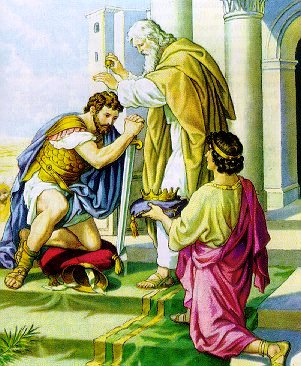
Today we begin the book of Second Samuel! Below is an image of David being anointed king of Judah from chapter 2 verse 4 in today’s readings:
Second Samuel
Author: Unknown
Date: Probably tenth century B.C.
Content: Second Samuel covers approximately forty years, which is the bulk of David’s reign as king. It begins with David’s being proclaimed king and consolidating his position against others who claimed the throne. David moved the capital to Jerusalem, brought the sacred Ark of the Covenant there, and ultimately defeated the Philistines for all time. David’s troubled career is described in some detail, including his family problems (his son Absalom) and his personal problems (adultery with Bathsheba). A summary of David’s later years concludes the book.
Theme: The life of David is given as an example of good and of evil. The sins of David are exposed – so that too much trust will not be put in men. The victories of David are recorded – so that it may be seen what God can do with someone who wholly trusts in him. God used David in spite of his faults because he found in David a willingness to repent and start again, no matter how far he had fallen. (Above commentary is from Tyndale Publishers “The One Year Bible Companion” pp. 5-6) More commentary on Second Samuel is at these 2 links –
http://bible.org/page.php?page_id=557
http://bible.org/page.php?page_id=965
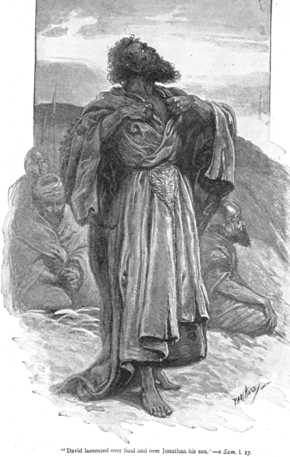
A note on the Amalekite that comes to David with news of Saul’s death in Second Samuel chapter 1 today. Many Bible commentaries suggest that this Amalekite was a war “scavenger” that was looking for treasures on the battle field from the dead. Based on 1 Samuel chapter 31, it is thought that this Amalekite found Saul dead, grabbed Saul’s crown before the Philistines arrived, and made up the story of killing Saul to David because he thought David would reward him for killing who he thought was David’s “enemy.” David’s reaction was quite the opposite than what the Amalekite thought it would be… Bible.org’s commentary on our Second Samuel readings today titled “What an Amalekite is Dying to Tell David” is at this link. Below is an image of David tearing his garments and lamenting the death of Saul:
Today in 2 Samuel chapter 1 we read about David’s lament for Saul & Jonathan. This year in going through the One Year Bible, I have really been intrigued by Jonathan and David’s relationship. They became incredible “brothers” it seems – much like we now have “brothers” and “sisters” in Christ today. And there seems to have been an amazing love between Jonathan and David – not sexual in any way, but a pure brotherly love. In verse 26 we will read – “I grieve for you Jonathan my brother; you were very dear to me. Your love for me was wonderful.” Personally, I have been thinking about this word “love” quite a bit in recent months. I don’t know if this is going to sound strange – I hope it’s a good sign 🙂 – but I find myself using the word “love” more and more often when referring to and thinking of others in my life. I have found myself saying recently, for example, “there are so many people in my church that I love and I believe love me.” I guess I’m getting to this stage in my life that may seem at first glance sentimental – but I think it is something more. I believe God is love. And yes, God is judge and many other things. But I do believe that love is a very godly thing. And I guess I’m getting to the point in life where I realize that I truly do love so many people in my life – with a brotherly or sisterly love – and maybe perhaps a few love me too. I pray this is the case in some way in your life? Are there people in your life that you love with a brotherly or sisterly love? Are there people in your life that were like Jonathan was to David? Are there people in your life where you are like Jonathan was to David? How familiar are you with love as expressed in 1 Corinthians 13? Did Jonathan have this type of love? Do you? Below is a portrait of David & Jonathan by artist Guy Rowe:

Worship God: Today’s readings in 1 Samuel reminded me of Lifehouse’s song “Hanging By a Moment:”
http://www.youtube.com/watch?v=OgStk7WlheE
Are you hanging by a moment? Click here for a life changing Moment!
Please join us in memorizing and meditating on two verses of Scripture today: “Saul died because he was unfaithful to the LORD; he did not keep the word of the LORD and even consulted a medium for guidance, and did not inquire of the LORD. So the LORD put him to death and turned the kingdom over to David son of Jesse. ” 1 Chronicles 10:13-14 (NIV)
Prayer Point: Pray that you will never be unfaithful to the LORD.
Comments from You: What verses or insights stand out to you in today’s readings? Please post up by clicking on the “Comments” link below!
God bless,
Mike

 Chronological Bible Blog
Leave a comment